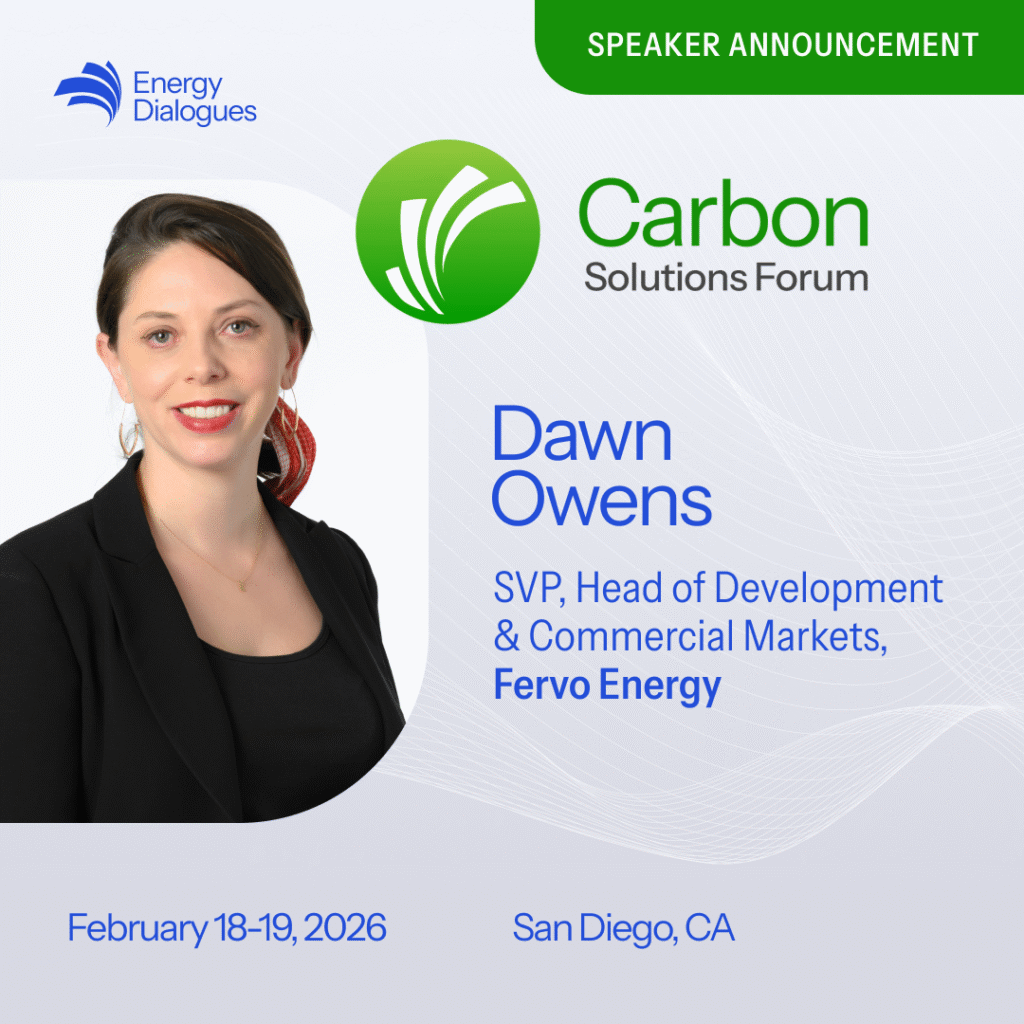
Fervo Energy’s SVP Dawn Owens on Making Enhanced Geothermal Bankable — CSF 2026 Speaker Preview
Ahead of the 2026 Carbon Solutions Forum, Energy Dialogues sits down with senior leaders who are translating carbon management ambition into bankable projects and infrastructure-grade outcomes.
In this speaker preview interview, Dawn Owens, SVP and Head of Project Development and Commercial Markets at Fervo Energy, discusses what buyers now demand from firm, low-carbon power, and what it takes to make enhanced geothermal repeatable at commercial scale. She unpacks how diligence has shifted toward schedule and execution, why interconnection and deliverability constraints now dominate risk conversations, and what needs to be standardized across permitting playbooks, contracting terms, execution systems, and lender-ready underwriting packages so projects can move from first-of-a-kind to financeable infrastructure.
This interview is part of the Energy Dialogues Speaker Series and our ongoing commitment to convening pragmatic, solutions-focused conversations on carbon management. As we build toward the Carbon Solutions Forum, we are engaging early with leaders advancing bankable contracting, realistic risk allocation, and underwriting frameworks that can scale repeatable development across the firm low-carbon mix.
Dawn, thanks for joining us in this preview to the Carbon Solution Forum. As demand for reliable, low-carbon power grows across multiple sectors, how have buyer expectations around uptime, delivery risk, and cost certainty evolved over the past 12–18 months and where does geothermal still face skepticism?
Over the last couple of years, buyers have become much more focused on schedule and execution. Timing has become the priority for almost any power resource. When you add clean and firm on top of that, it becomes one of the most valuable products out there.
Where skepticism shows up it is usually not specific to geothermal. Most of the concern is aimed at the same challenges that affect every power project right now. Interconnection risk, deliverability requirements, and long lead equipment like transformers and circuit breakers are still front of mind for buyers, and these issues tend to dominate diligence conversations.
Enhanced geothermal has proven its technical feasibility, but commercial scale depends on repeatability. What have recent projects and negotiations revealed about what must be standardized to move geothermal from first-of-a-kind deployments to infrastructure-grade assets that capital providers and buyers can underwrite with confidence?
The big lesson is that scale comes from repeatability, and repeatability comes from standardization. The more we can make the process consistent from project to project, the more confidence buyers and lenders can have in schedule, performance, and cost outcomes.
A few areas matter most. First, permitting and interconnection need playbooks with predictable timelines, clear gates, and repeatable stakeholder processes. Second, contracts need more consistency so the basic terms are not renegotiated every time. That includes clear definitions for COD, performance testing, availability, and remedies.
Third, execution needs to look more like a system and manufacturing process which Fervo is well on its way to developing. Finally, the underwriting package has to be repeatable too. A lender packet that looks the same each time, with schedule logic, a risk register, contingency sizing, and performance evidence, makes it easier for independent engineers and credit committees to get comfortable.
It is a balance between improvement and iteration versus standardization and we believe that we are striking the right balance as we come down the learning curve.
Permitting timelines, interconnection delays, and evolving policy frameworks continue to shape firm power development. How is Fervo structuring offtake agreements and risk allocation to remain bankable? Have recent regulatory signals begun to reduce uncertainty?
Bankability today is driven by clarity and alignment. We focus on setting clear milestones and objective tests for delivery and COD, so both sides understand what success looks like and how it is measured.
On regulatory signals, I would not say uncertainty is gone, but in general, EGS aligns well with a policy environment focused on energy abundance, security, and domestic supply.esents an important complementary product to SAF for the airline industry that addresses value chain emissions. We are eager to explore these innovative opportunities.
Geothermal is increasingly discussed alongside CCS-enabled gas, nuclear, and hybrid solutions as part of the firm low-carbon mix. Where does geothermal have a clear advantage today, and where does it still struggle to compete on cost, speed, or scalability?
Geothermal’s advantage is that it can provide true firm output with near-term scalability. There is no fuel supply chain to manage and no fuel price exposure. In markets where timing matters, deliverable megawatts on the right schedule are more desirable than theoretical capacity.
Where it can struggle is due to system bottlenecks rather than the technology itself. Interconnection, deliverability requirements, and long lead equipment can still set the pace. Those constraints affect most resources.
Many low-carbon power projects stall before reaching FID. From your experience, what investor expectations or commercial proof points ultimately determine whether capital moves?
In my experience, capital moves when the project stops looking like a technology bet and starts looking like a manageable execution plan.
This means a credible path to COD that holds up under independent scrutiny, with real contingency built in. Repeatability matters a lot, both in well delivery outcomes and in the playbook for setbacks. The question is whether issues can be managed without breakingschedule, budget, or economics. Cost certainty is the other major proof point. That includes clear EPC scope, a realistic escalation strategy, a supply chain plan, and contingency sizing that matches the actual risks.
Fervo Energy is joining the Carbon Solutions Forum. What makes the Forum a valuable platform for your team this year, and which conversations are you most eager to advance in San Diego.
It is valuable because it brings the commercial, policy, and infrastructure stakeholders into the same room, and the conversations tend to be practical.
In San Diego, we are most focused on advancing standard firm power contracting that can scale, practical approaches to interconnection and deliverability risk that reflect how projects actually get built, and underwriting frameworks for repeatable geothermaldevelopment so the market can treat these assets as infrastructure rather than exceptions.